
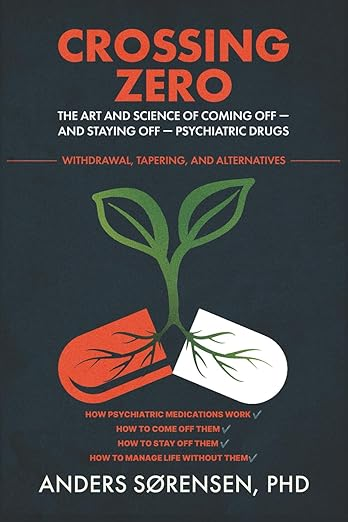
The Crossing Zero
The Art and Science of Coming Off—and Staying Off—Psychiatric Drugs by Danish clinical psychologist and researcher Anders Sørensen, PhD.
Summary of “Crossing Zero”
The core thesis of Crossing Zero is that psychiatric deprescribing (tapering off psychiatric medications) is not merely a biological process of dose reduction but a profound emotional, psychological, and social transformation. Sørensen bridges the gap between rigorous pharmacological science and humanistic psychotherapy.
The book is structured around two central pillars:
1. The Science: Hyperbolic Tapering
- The Problem with Linear Tapering: Standard medical advice often recommends reducing medication linearly (e.g., by 5 mg every two weeks). Sørensen explains why this fails: drug-receptor occupancy in the brain does not decrease linearly. Instead, it follows a hyperbolic curve.
- The Steep Final Drop: At very high doses, a large drop in milligrams per dose causes only a tiny change in receptor blockade. However, at very low doses, even a tiny drop in milligrams can cause a massive, sudden decline in receptor occupancy.
- “Crossing Zero”: The book teaches “hyperbolic tapering”—reducing doses by progressively smaller percentages as the dose approaches zero. This minimizes the shock to the central nervous system, safely guiding the patient through the steepest, most dangerous final leg of the withdrawal journey.
2. The Art: Reclaiming Identity and Agency
- Shedding the “Patient” Identity: For many, being on psychiatric drugs shapes their identity as “defective” or “chronically ill.” Tapering off requires departing from this disease-centered model and reclaiming personal agency.
- Navigating Re-emerging Emotions: As psychiatric drugs (which often numb emotions) are cleared from the system, patients experience a flood of raw, dormant feelings. Sørensen argues these are normal emotional reactions and withdrawal symptoms, not a “relapse” of the underlying psychiatric illness.
- The Danger of Over-Scrutiny: Sørensen highlights how family, friends, and doctors can accidentally sabotage recovery by constantly scrutinizing the tapering individual, treating completely normal human mood fluctuations as “symptoms” of a relapse.
Critique of the Goal: “Coming Off—and Staying Off—Psychiatric Drugs”
Sørensen’s goal is to provide a safe roadmap for people who wish to deprescribe, challenging the prevailing pharmaceutical paradigm that often treats psychiatric conditions as lifetime chemical imbalances requiring permanent medication.
The Strengths (Why the Goal is Vital)
- Corrects a Massive Clinical Gap: For decades, psychiatry has focused heavily on how to start drugs, with remarkably little training or research dedicated to how to stop them. Sørensen’s book provides a much-needed, scientifically grounded framework for deprescribing.
- Validates the Patient Experience: Millions of patients worldwide have been told their withdrawal symptoms are actually “relapses,” trapping them on medication indefinitely. By reframing these symptoms, Sørensen validates their lived experience and offers hope.
- Combats Over-Medicalization: It pushes back against the trend of diagnosing and medicating normal human suffering (such as grief, stress, or situational trauma), encouraging people to build psychological resilience instead of relying on chemical numbing.
The Limitations & Risks (A Critical Counterpoint)
- The Risk of Over-Generalization: While over-prescribing is a massive systemic issue, there is a segment of the population with severe, chronic psychiatric conditions (e.g., severe bipolar I or refractory schizophrenia) for whom long-term medication is a life-saving stabilizer. A generalized cultural push toward “crossing zero” could inadvertently shame these individuals or encourage dangerous discontinuation.
- Practical Hurdles of Hyperbolic Tapering: Hyperbolic tapering requires highly precise micro-dosing (such as using liquid formulations, crushing tablets, or weighing powder on jeweler’s scales). In many healthcare systems, doctors are untrained in this, and compounding pharmacies are expensive or inaccessible, making Sørensen’s scientific ideals incredibly difficult for the average patient to execute safely.
- Potential for Unsupervised, Dangerous Tapering: Books advocating for deprescribing can sometimes be read as DIY manuals by desperate patients. Even with Sørensen’s warnings, reading about “coming off” can encourage patients to attempt tapering without a supportive clinical safety net, which can lead to severe, long-lasting destabilization or withdrawal-induced crises.

The Verdict: Sørensen’s goal is incredibly noble and scientifically necessary. However, “Crossing Zero” is best viewed not as a universal mandate that everyone should come off medication, but rather as an essential guide proving that for those who choose to do so, it can be done safely, compassionately, and successfully.