
Your Eyes in Psychiatric Clinical Settings:
Eye findings can support a psychiatric assessment, but they are never diagnostic on their own. Many eye signs are influenced by lighting, sleep, drugs, neurological illness, endocrine disease, and culture. Therefore, describe “Eye appearance” objectively rather than interpreting it as a fixed personality trait.
1. Useful descriptive eye observations in the mental-state examination
- Eye contact: absent, fleeting, avoidant, intense, staring, guarded, socially appropriate, or overfamiliar.
- Gaze direction: downward, scanning, fixed, internally preoccupied, suspiciously monitoring the room.
- Blink rate: reduced, normal, increased.
- Pupil size/reactivity: constricted, normal, dilated, unequal, or poorly reactive.
- Eye movements: nystagmus, tremor, impaired pursuit, saccades, convergence difficulty, ocular deviation.
- Eyelids/periorbital appearance: ptosis, lid retraction, wide-eyed appearance, dark circles, redness.
- Facial–ocular congruence: whether the eyes, facial expression, speech, and emotional content fit together.
2. Eye signs in common psychiatric conditions
| Condition | Possible eye appearance or behavior | Clinical meaning and caution |
|---|---|---|
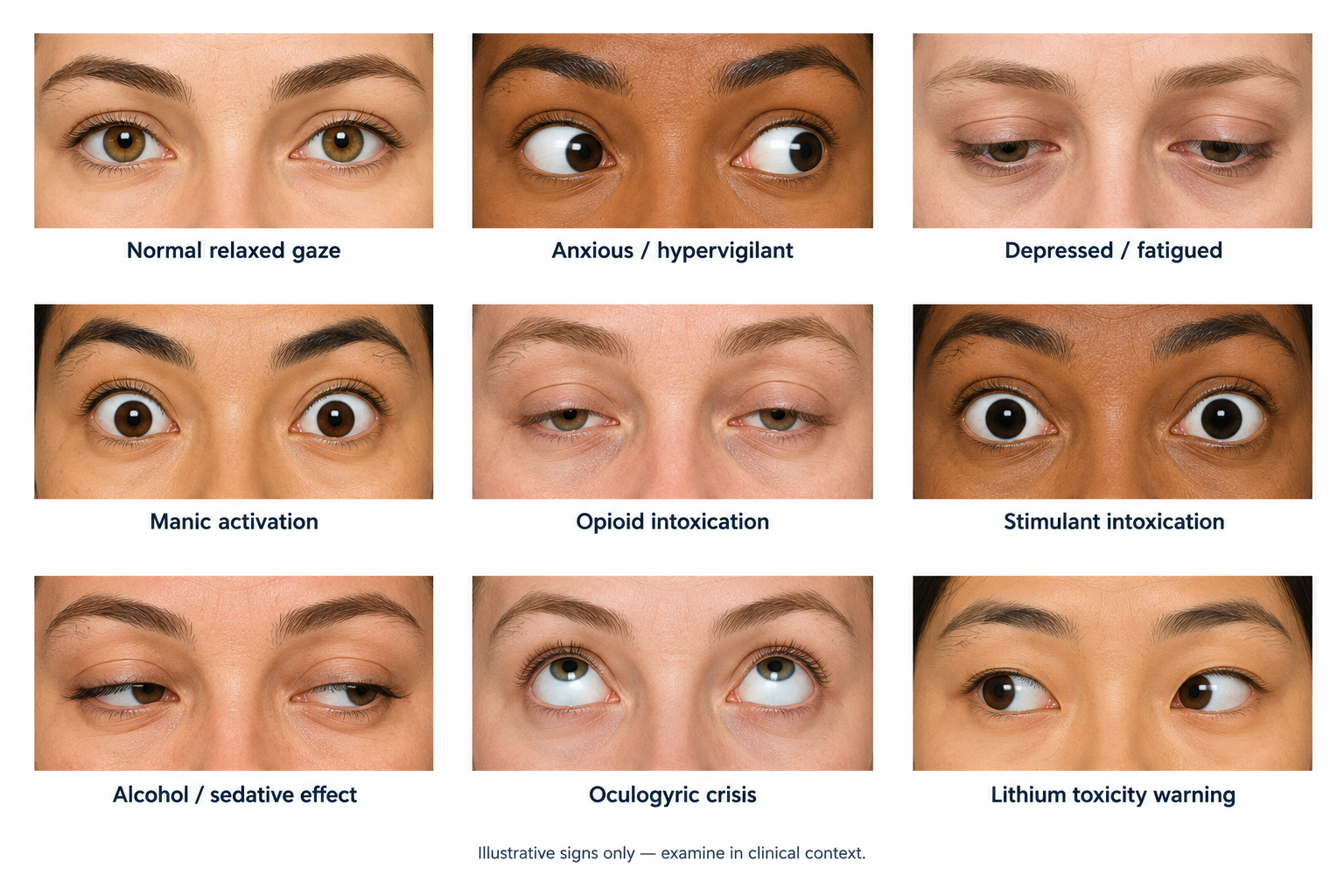
| Major depressive disorder | Downcast gaze, reduced spontaneous eye contact, tearfulness, slowed blinking or psychomotor retardation | May reflect low mood, shame, low energy, or reduced social engagement. It is not specific. |
| Mania / hypomania | Bright or intense gaze, frequent scanning, increased eye contact, rapid shifting attention, reduced blinking | Often accompanies increased arousal, distractibility, overfamiliarity, and psychomotor activation. Dilated pupils may also occur with stimulants. |
| Schizophrenia spectrum disorders | Variable eye contact; staring, guarded scanning, looking toward unseen stimuli, reduced facial expressiveness | Looking aside or responding visually to something not present may accompany hallucinations or internal preoccupation. A “fixed stare” can also be due to catatonia, medication effects, or anxiety. |
| Paranoia / persecutory delusions | Vigilant scanning of doors/windows, monitoring others, brief guarded eye contact | May reflect hypervigilance and mistrust. Do not interpret this alone as paranoia. |
| Anxiety disorders | Rapid scanning, increased blinking, avoidance of sustained gaze, widened eyes | Arousal and threat monitoring are common. Social anxiety often produces gaze avoidance because direct gaze feels evaluative or threatening. |
| Panic attack | Wide eyes, dilated pupils, rapid eye movements, visual “tunnel” complaints | Sympathetic activation may cause mydriasis, blurred vision, light-headedness, and derealization. |
| PTSD | Hypervigilant scanning, exaggerated response to movement, reduced sustained eye contact, “frozen” stare during dissociation | May suggest threat monitoring or dissociation; ask about trauma symptoms rather than making assumptions. |
| Dissociation | Distant or unfocused gaze, reduced responsiveness, staring, variable eye contact | Can occur during depersonalization/derealization or dissociative episodes. Exclude seizures, intoxication, delirium, and neurological causes. |
| Autism spectrum condition | Variable eye contact; may be reduced, brief, or strategically managed | This reflects differences in social communication and sensory processing, not dishonesty, indifference, or lack of empathy. |
| Delirium | Inattentive gaze, fluctuating alertness, poor visual tracking, sometimes visual misperceptions | Treat as a medical emergency until proven otherwise, especially with acute onset and fluctuating consciousness. |
| Catatonia | Fixed gaze, staring, reduced blinking, gaze immobility, withdrawal | Look for immobility, mutism, negativism, posturing, echophenomena, and autonomic instability. |
| Eating disorders | Dark circles, tired appearance, dry eyes; occasionally subconjunctival hemorrhage after vomiting | The eye itself is not diagnostic. Assess dehydration, electrolyte disturbance, medical instability, and self-induced vomiting. |
| Substance intoxication or withdrawal | See below | Pupils and eye movements are often more informative than apparent “expression.” |
| State | Typical eye signs | Important clinical note |
| Opioid intoxication | Pinpoint pupils, drowsy or drooping gaze | Respiratory depression is the major emergency. Pupils may not be pinpoint in mixed overdoses. |
| Stimulant intoxication: cocaine, amphetamine, methamphetamine | Dilated pupils, intense or restless gaze, reduced blinking, rapid scanning | Assess agitation, psychosis, hyperthermia, chest pain, and sleep deprivation. |
| Cannabis intoxication | Red conjunctivae, mild pupil dilation or normal pupils, slowed visual tracking | Red eyes are nonspecific and may reflect allergy or irritation. |
| Alcohol intoxication | Nystagmus, impaired smooth pursuit, conjunctival injection, drooping eyelids | Horizontal gaze-evoked nystagmus may occur, but examination must not be used as a stand-alone legal determination of intoxication. |
| Sedative-hypnotic intoxication | Nystagmus, slowed eye movements, drooping eyelids, poor visual tracking | Consider benzodiazepines, barbiturates, anticonvulsants, and mixed ingestion. |
| Hallucinogens | Dilated pupils, visual fixation or scanning, altered visual perception | Assess for panic, dangerous behaviour, and co-ingestants. |
| Alcohol or benzodiazepine withdrawal | Anxiety, dilated pupils, tremor, hypervigilant gaze | Severe withdrawal can progress to seizures or delirium tremens. |
3. Pupils and eye movements in substance-related states
| State | Typical eye signs | Important clinical note | |—|—|—|
| Opioid intoxication | Pinpoint pupils, drowsy or drooping gaze | Respiratory depression is the major emergency. Pupils may not be pinpoint in mixed overdoses. |
| Stimulant intoxication: cocaine, amphetamine, methamphetamine | Dilated pupils, intense or restless gaze, reduced blinking, rapid scanning | Assess agitation, psychosis, hyperthermia, chest pain, and sleep deprivation. |
| Cannabis intoxication | Red conjunctivae, mild pupil dilation or normal pupils, slowed visual tracking | Red eyes are nonspecific and may reflect allergy or irritation. |
| Alcohol intoxication | Nystagmus, impaired smooth pursuit, conjunctival injection, drooping eyelids | Horizontal gaze-evoked nystagmus may occur, but examination must not be used as a stand-alone legal determination of intoxication. |
| Sedative-hypnotic intoxication | Nystagmus, slowed eye movements, drooping eyelids, poor visual tracking | Consider benzodiazepines, barbiturates, anticonvulsants, and mixed ingestion. |
| Hallucinogens | Dilated pupils, visual fixation or scanning, altered visual perception | Assess for panic, dangerous behavior, and co-ingestants. |
| Alcohol or benzodiazepine withdrawal | Anxiety, dilated pupils, tremor, hypervigilant gaze | Severe withdrawal can progress to seizures or delirium tremens. |
4. Eye effects of psychiatric medications
- Anticholinergic drugs — including tricyclic antidepressants, low-potency antipsychotics, antiparkinsonian drugs, and some antihistamines: blurred vision, impaired accommodation, dry eyes, and dilated pupils. They can precipitate acute angle-closure glaucoma in susceptible people.
- SSRIs/SNRIs: may cause dry eye, blurred vision, or mydriasis; rarely may contribute to angle-closure glaucoma in anatomically predisposed patients.
- Antipsychotics: blurred vision and accommodation difficulty can occur through anticholinergic effects. Rarely, they may cause ocular dystonia or oculogyric crisis.
- Oculogyric crisis: sustained involuntary upward or lateral deviation of the eyes, often with distress, neck dystonia, and restlessness. It is an acute dystonic reaction, more likely with high-potency dopamine-blocking agents. It requires prompt treatment per local protocol, commonly with an anticholinergic medication.
- Lithium: fine gaze-evoked nystagmus, blurred vision, and abnormal eye movements may be early clues to toxicity. Coarse tremor, ataxia, confusion, vomiting, or marked nystagmus require urgent lithium-level and medical assessment.
- Benzodiazepines and sedating agents: slowed saccades, reduced smooth pursuit, drowsy eyes, and impaired coordination.
- Clozapine: can cause blurred vision, accommodation problems, and hypersalivation-related irritation; sudden visual symptoms should still trigger medical assessment rather than being assumed to be medication-related.
5. “Normal eye look” in personality and character
No scientifically valid eye appearance proves a personality type, moral character, honesty, dangerousness, intelligence, or psychiatric diagnosis. Claims such as “shifty eyes mean lying,” “cold eyes mean psychopathy,” or “large eyes mean innocence” are stereotypes and are clinically unsafe.
What can be assessed is the person’s usual interpersonal style in context:
- Reserved or introverted style: may use less prolonged eye contact, especially with unfamiliar people; this can be entirely normal.
- Confident or socially engaged style: may maintain comfortable, reciprocal eye contact, without staring.
- Anxious style: may look away frequently, blink more, or monitor the interviewer’s reactions.
- Culturally respectful style: in some cultures or hierarchical relationships, prolonged direct eye contact may be avoided as a sign of respect.
- Expressive temperament: gaze and facial expression may be more animated.
- Neurodivergent communication style: eye contact may be reduced, intermittent, or consciously managed, while comprehension and empathy remain intact.
The clinically appropriate question is not “What character does this eye look reveal?” but: Is this person’s gaze and visual behavior a change from their baseline, and does it fit the current mental and medical state?
6. Red flags requiring urgent medical or neurological assessment
Urgently assess or refer if there is:
- New unequal pupils, a fixed dilated pupil, or severe eye pain/redness.
- New diplopia, visual loss, visual-field defect, or persistent blurred vision.
- Acute confusion, fluctuating consciousness, or new visual hallucinations in an older or medically unwell patient.
- New nystagmus with ataxia, vomiting, dysarthria, or confusion.
- Sustained upward eye deviation suggesting oculogyric crisis.
- Suspected lithium toxicity.
- Seizure activity, postictal confusion, or possible non-convulsive status epilepticus.
- Severe headache with visual symptoms, hypertension, fever, neck stiffness, or focal neurological signs.
A good psychiatric eye examination therefore combines observation, medication review, neurological screening, and respect for individual and cultural variation.
Clinical and Psychological Notes on Reading Emotional Expressions
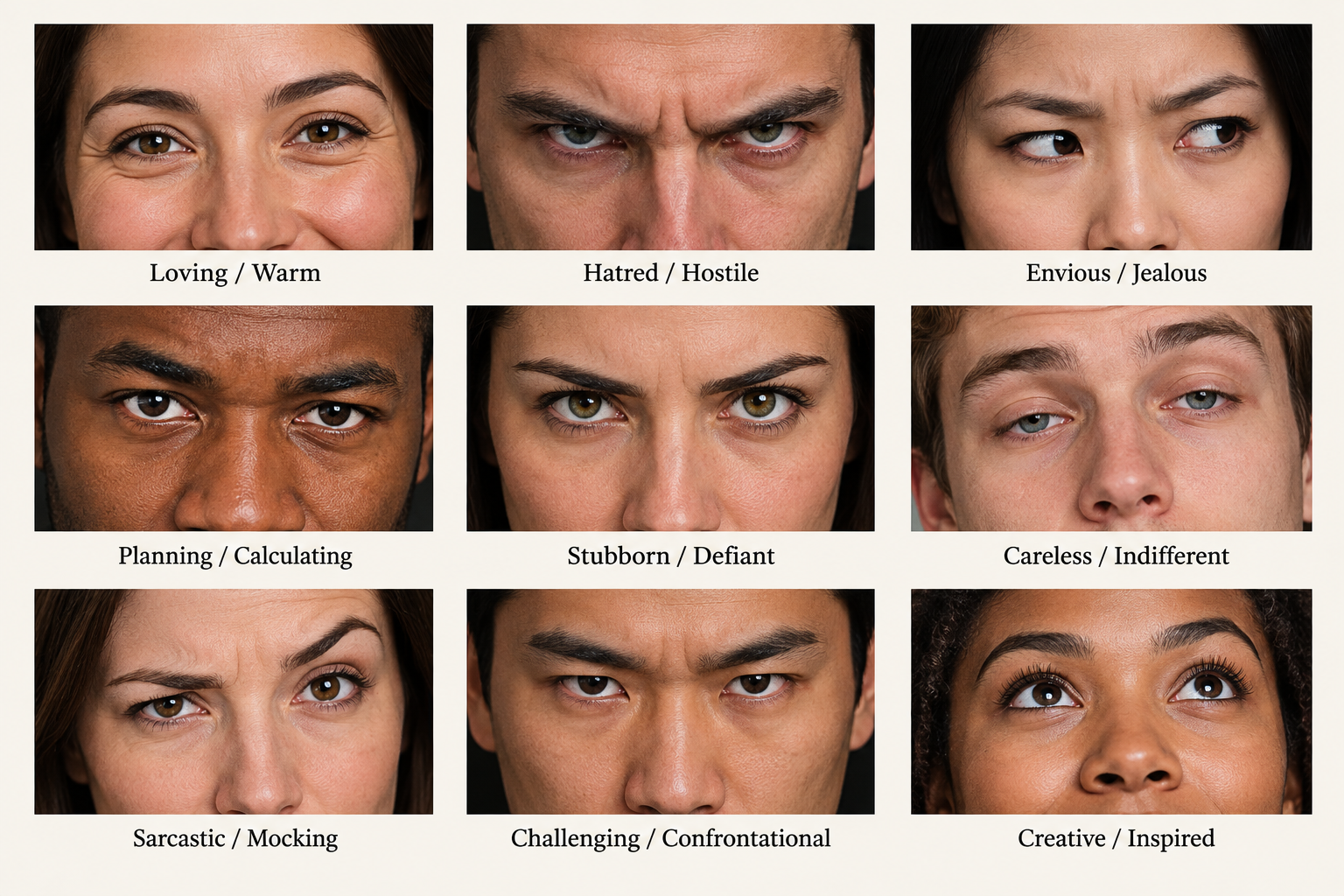
In clinical interviews and interpersonal communication, what we perceive as “the look in someone’s eyes” is driven by a combination of the periorbital musculature (orbicularis oculi, corrugator supercilii, procerus, and frontalis), pupil dynamics, blink frequency, and gaze vector:
- Loving / Warm:
- Key markers: Contraction of the outer orbicularis oculi (Duchenne marker producing genuine crow’s-feet crinkling), relaxed brow, steady soft focal depth, and slight autonomic pupillary dilation in response to positive valence.
Hatred / Hostile:
- Key markers: Marked corrugator contraction drawing eyebrows medially and downward (glabellar furrows), palpebral fissure narrowing, intense hard focal lock, and scleral exposure restricted to an accusatory glint.
Envious / Jealous:
- Key markers: Lateral or oblique gaze aversion mixed with covert appraisal; asymmetric brow tension; subtle narrowing indicating critical evaluation combined with resentment.
Planning / Calculating:
- Key markers: Sustained convergence with a steady, unhurried focal axis; slightly lowered brow indicating cognitive load and internal schema manipulation; reduced spontaneous blink rate.
Stubborn / Defiant:
- Key markers: Unyielding direct eye contact, set medial brow, minimal head repositioning during challenge, indicating resistance and refusal to submit to interpersonal cues.
Careless / Indifferent:
- Key markers: Partial ptosis / relaxed levator palpebrae, unfocused or drifting focal point, absent micro-saccades toward the speaker, indicating lack of emotional engagement or disinterest.
Sarcastic / Mocking:
- Key markers: Marked asymmetry—one eyebrow elevated (unilateral frontalis contraction) while the opposite eye is narrowed in skeptical assessment; brief upward ocular micro-rolls.
Challenging / Confrontational:
- Key markers: Direct, widened palpebral aperture with exposed sclera above or below the iris (“predatory or dominant gaze”), locked fixation, and an unblinking confrontation threshold.
Creative / Inspired:
- Key markers: Upward or divergent visual trajectory (reflecting internal visual-spatial imagery and cognitive search), elevated brows, open palpebral fissures, and a luminous, receptive gaze.
Clinical Reminder for Presentations:
While these micro-expressions provide rapid non-verbal feedback during rapport building and mental state examinations, they reflect transient emotional states and interpersonal stances rather than permanent personality traits. Context, baseline temperament, and cultural background must always guide interpretation.
The Anatomy and Psychology of Romantic Attraction in the Gaze
The physiological and non-verbal cues that make an eye gaze deeply captivating and romantic rely on several interrelated factors:
Pupillary Mydriasis (The Autonomic Flirtation Signal):
- When viewing someone you find emotionally or romantically interesting, sympathetic tone increases, causing transient, subtle pupillary dilation. Observers subconsciously interpret larger pupils as a sign of genuine attraction and warmth.
Duchenne “Smiling with the Eyes”:
- The pars orbitalis of the orbicularis oculi contracts involuntarily during authentic positive affect, drawing the outer corners of the eyelids upward and creating soft dynamic skin folds (“crow’s feet”). This distinguishes warm connection from a deliberate or mechanical smile.
Limbal Ring Prominence:
- The dark ring surrounding the iris (the limbal ring) contrasts against the sclera, visually enhancing corneal clarity, brightness, and youthfulness—features cross-culturally associated with vitality.
Copious Lacrimal Film & Catchlights:
- Optimal hydration and micro-lacrimation create a high-refraction corneal surface that catches ambient light points (“sparkle” or glint in the eye), signaling alertness and emotional engagement.
Prolonged Reciprocal Gaze & Micro-Aversion:
- Rather than an unblinking stare (which triggers threat evaluation) or rapid glance avoidance (anxiety/guilt), romantic allure involves sustained direct eye contact for 3–5 seconds, followed by a shy downward or sideways micro-glance, then a return to the gaze, signaling playful reciprocity and intimacy.